I. A Political Flashpoint Reignites an Old Debate
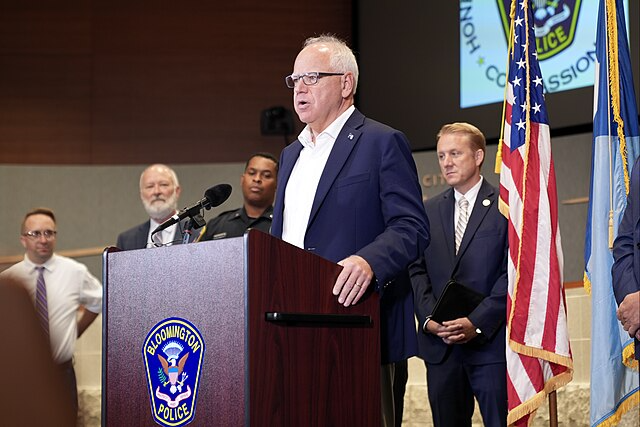
Gov. Tim Walz’s decision to exit the gubernatorial race has revived national attention on long-standing allegations of fraud in Minnesota’s childcare and nutrition programs. The renewed scrutiny has resurfaced a narrative portraying the state as the site of a newly uncovered, sweeping scandal — a storyline amplified by political actors and viral media.
But the documented record tells a more complicated story: one shaped by real fraud, persistent oversight failures, and a recent wave of unverified claims that have blurred the boundaries between evidence and speculation.
II. Fraud Grew for Years — Walz Administration Referred It to the FBI
The timeline of the Feeding Our Future case complicates attempts to pin responsibility on a single administration. Legislative audits from 2015, 2016, and 2018 — years before Gov. Tim Walz took office — documented persistent weaknesses in Minnesota’s oversight systems, including inconsistent verification, delayed responses to red flags, and limited investigative capacity. Those vulnerabilities remained in place when the pandemic hit, and emergency federal waivers loosened program rules nationwide. Charging documents show that the bulk of the fraudulent activity occurred during this period, when program scale expanded rapidly and longstanding weaknesses were magnified.
At the same time, it was the Walz administration that initiated the referral that led to the federal investigation. After internal concerns escalated in 2021, the Department of Human Services attempted to suspend payments to Feeding Our Future, was sued by the organization, and ultimately referred the matter to the FBI. Federal agents executed search warrants in early 2022, and indictments followed. The fraud occurred during Walz’s tenure, but the enabling conditions predated him, and his administration triggered the investigation that brought the scheme to light.
III. Proven Fraud: A Large Case, Years in the Making
Verified fraud within programs intended to serve children in Minnesota is not in dispute. Federal prosecutors brought one of the nation’s largest pandemic-era fraud cases through the Feeding Our Future investigation, which uncovered the theft of roughly $250 million in federally funded child-nutrition dollars. The case demonstrated how emergency spending, weak internal controls, and delayed oversight created openings for organized exploitation. Legislative audits later found that state agencies failed to respond to early warning signs, allowing the scheme to expand before intervention occurred.
IV. CCAP: A Decade of Warnings, Uneven Enforcement
Concerns about fraud in Minnesota’s Child Care Assistance Program (CCAP) predate the current political moment by more than a decade. Beginning in the mid-2010s, whistleblowers and auditors flagged suspicious billing patterns and attendance reporting to the Minnesota Department of Human Services. While some criminal cases followed, most findings pointed to systemic weaknesses — inconsistent verification, incomplete documentation, and limited enforcement capacity — rather than a coordinated, statewide fraud operation. These issues spanned multiple administrations and were never fully resolved.
V. Viral Media Recasts Old Problems as New Scandal
What has changed recently is not the emergence of new fraud, but the way the issue is being narrated. A viral video circulated online claiming to show daycare centers that appeared empty or inactive while receiving public funds, implying the existence of a newly uncovered, widespread scheme. The footage spread quickly and was amplified by political figures in Washington as evidence of systemic abuse, with senior officials in the Trump administration citing it as justification for targeted investigations in Minnesota and other “blue states”. These actions strategically fuel ongoing rhetoric that casts immigrants as criminals despite what data shows and leverages the oversight failure against a high-profile Democratic Party official.
Follow-up reporting and regulatory records, however, do not support the claim that the video exposed new wrongdoing. Many of the centers shown were licensed, had undergone recent inspections, and were already known to regulators. No new fraud cases have been publicly substantiated as a result of the footage. Investigators did not find falsified attendance records, forged claims, or shell operations tied directly to the viral allegations.
The viral videos did not uncover new fraud; they repackaged existing concerns into a narrative that implied evidentiary findings where none have been substantiated.
VI. How Nationality Became a Narrative Driver
Public debate around the fraud cases has increasingly focused on the nationality and community background of some defendants, particularly in the Feeding Our Future investigation, where several individuals charged or convicted have Somali-origin names. That detail has taken on an outsized role in online commentary, even though state and federal investigators have not identified nationality as a causal factor in the underlying schemes. Oversight failures documented in audits were administrative, not demographic, and the state’s broader history of childcare and nutrition-program irregularities spans multiple providers and backgrounds.
VII. Citizenship Questions VS Available Data
Citizenship status has also become part of the public debate, though official records provide no comprehensive breakdown. Many of the defendants have names that appear to be of Somali origin, and reporting has described a majority as Somali-American — a term that encompasses both U.S.-born and naturalized citizens. At least one defendant has been accused of misrepresenting his citizenship on immigration forms, but federal prosecutors do not track or publish citizenship data for the group as a whole, and no evidence indicates that immigration status played any role in the mechanics of the fraud.
VIII. The National Context: Fraud in America Is Not Demographically Tracked
National fraud data does not identify perpetrators by race, ethnicity, or citizenship. Federal agencies track fraud by scheme type, dollar loss, and method, not by demographic categories. The vast majority of fraud in the United States involves identity theft, financial scams, and cybercrime networks that span multiple countries and communities. Program-specific fraud cases, such as Minnesota’s, represent a small fraction of overall fraud activity and cannot be used to draw conclusions about broader demographic patterns.
IX. Oversight Failures, Proven Crimes, and Viral Claims Collapse Into One Story
The reframing of Minnesota’s fraud history matters because it collapses distinctions that are central to understanding the issue. Proven fraud, audit-identified compliance failures, and unverified allegations are not interchangeable. When they are treated as equivalent, accountability becomes diffuse and accuracy suffers. Documented oversight failures risk being overshadowed by spectacle, while unsupported claims gain credibility through repetition and their proximity to legitimate cases.
X. A Political Response That Risks Distorting Enforcement
The political response has further complicated the landscape. Calls from federal officials to intensify investigations in Minnesota have introduced a partisan frame into what is typically a risk-based enforcement process. While Minnesota’s history justifies scrutiny of specific programs, orienting investigations around “blue states” or other political geography or viral narratives rather than documented vulnerabilities risks undermining the perceived independence and of oversight in favor of targeting political opponents and letting it persist elsewhere. When scrutiny follows the loudest narratives, similar risks where political allies exist may go unexamined.
XI. What the Minnesota Case Actually Represents
Taken together, the Minnesota case reflects not a single unfolding scandal but the convergence of three dynamics: real fraud that went undetected for years, persistent weaknesses in administrative oversight, and a recent surge of unsubstantiated viral claims. While the underlying fraud warranted serious enforcement, the subsequent response has blurred the line between proven crimes, compliance failures, and unsupported allegations — a blurring intensified by partisan rhetoric that threatens to politicize accountability while leaving comparable vulnerabilities in other jurisdictions unaddressed.
FACT CHECK: Minnesota Fraud Claims — What’s Supported, What Isn’t
1. Claim: The viral daycare videos uncovered new fraud.
What’s claimed
That the videos revealed a newly discovered, widespread fraud scheme involving empty or inactive daycare centers billing the state.
What the evidence shows
• State investigators reported that child care centers highlighted in the viral video were “operating as expected” during checks.
• Reporting notes that the state’s initial findings cast doubt on the video’s claims of fraud, while investigations continue.
• No new fraud cases have been publicly substantiated as a result of the videos.
• The video reframed existing concerns but did not produce new evidentiary findings.
Verdict: ❓ Unsupported
Rationale: The claim asserts evidentiary discovery not supported by public findings reported by mainstream outlets and state investigators. Source: CNN
2. Claim: The Feeding Our Future fraud occurred because of oversight failures under Gov. Tim Walz.
What’s claimed
That the fraud was caused by mismanagement or negligence specific to the Walz administration.
What the evidence shows
• The fraud and oversight failures span multiple time periods; Reuters reports the criminal case timeline and emphasizes the political amplification occurring now.
• Walz’s administration is described as responding amid crisis and signing an order creating a new investigative unit.
• The enabling conditions cited in public discussion include broader oversight weaknesses and pandemic-era scale pressures; assigning sole causation to one governor overstates the record.
Verdict: ⚠️ Misleading
Rationale: It is fair to scrutinize oversight during Walz’s tenure, but “because of Walz” implies sole or primary causation not established by the reporting referenced here. Source: Reuters
3. Claim: The state ignored warnings about Feeding Our Future.
What’s claimed
That Minnesota officials were blindsided and had no prior indications of risk.
What the evidence shows
• Reuters reports ongoing scrutiny and Walz’s stated focus on combating fraud; the public record includes prior disputes, litigation, and later federal action.
• A categorical “ignored” claim is too absolute: it collapses internal concern, legal constraints, and escalation dynamics into a single accusation.
Verdict: ⚠️ Misleading
Rationale: The claim is framed as total institutional inaction rather than a contested, time-extended oversight failure with documented escalation. Source: Reuters
4. Claim: The Feeding Our Future case was a single coordinated conspiracy.
What’s claimed
That the fraud represents one unified criminal network.
What the evidence shows
• Reuters describes broad prosecutions and guilty pleas within a large case, but broad scale does not itself prove a single centrally directed network.
• Descriptions of large fraud cases often include multiple defendants and operational clusters; “single coordinated conspiracy” is stronger than the reporting supports.
Verdict: ❓ Unsupported
Rationale: The claim asserts a specific organizational structure not established in the referenced reporting. Source: Reuters
Rationale: Publicly reported state checks found centers featured in the video operating as expected, and the state’s initial findings cast doubt on the fraud claims presented as “proof.” Source: CNN
Rationale: The claim is an evidence-free generalization; it substitutes political geography for risk-based indicators and is not supported by the reporting cited in this analysis. Source: MS NOW
Rationale: Referenced reporting emphasizes oversight failures and the viral-video-driven narrative cycle; demographic inference is not evidence of causation. Source: Reuters
Baseline (stated norm): Federal fraud enforcement should be risk-based and evidence-driven, targeting documented vulnerabilities wherever they occur.
Follow-up (current frame): Public calls to intensify scrutiny in Minnesota and other “blue states,” amplified alongside unsubstantiated viral claims.
Assessment: Severity 3 — The enforcement frame shifts from evidence-first scrutiny to politically keyed targeting, risking both credibility and missed fraud risks elsewhere if attention follows partisan narratives rather than consistent indicators. Source: MS NOW
| Outlet | Bar | Score |
|---|
| Outlet | Spin | Factual integrity | Strategic silence | Media distortion |
|---|
| Outlet | Spin | Factual integrity | Strategic silence | Media distortion |
|---|---|---|---|---|
| Populate via DATA.cm.rationales | ||||