
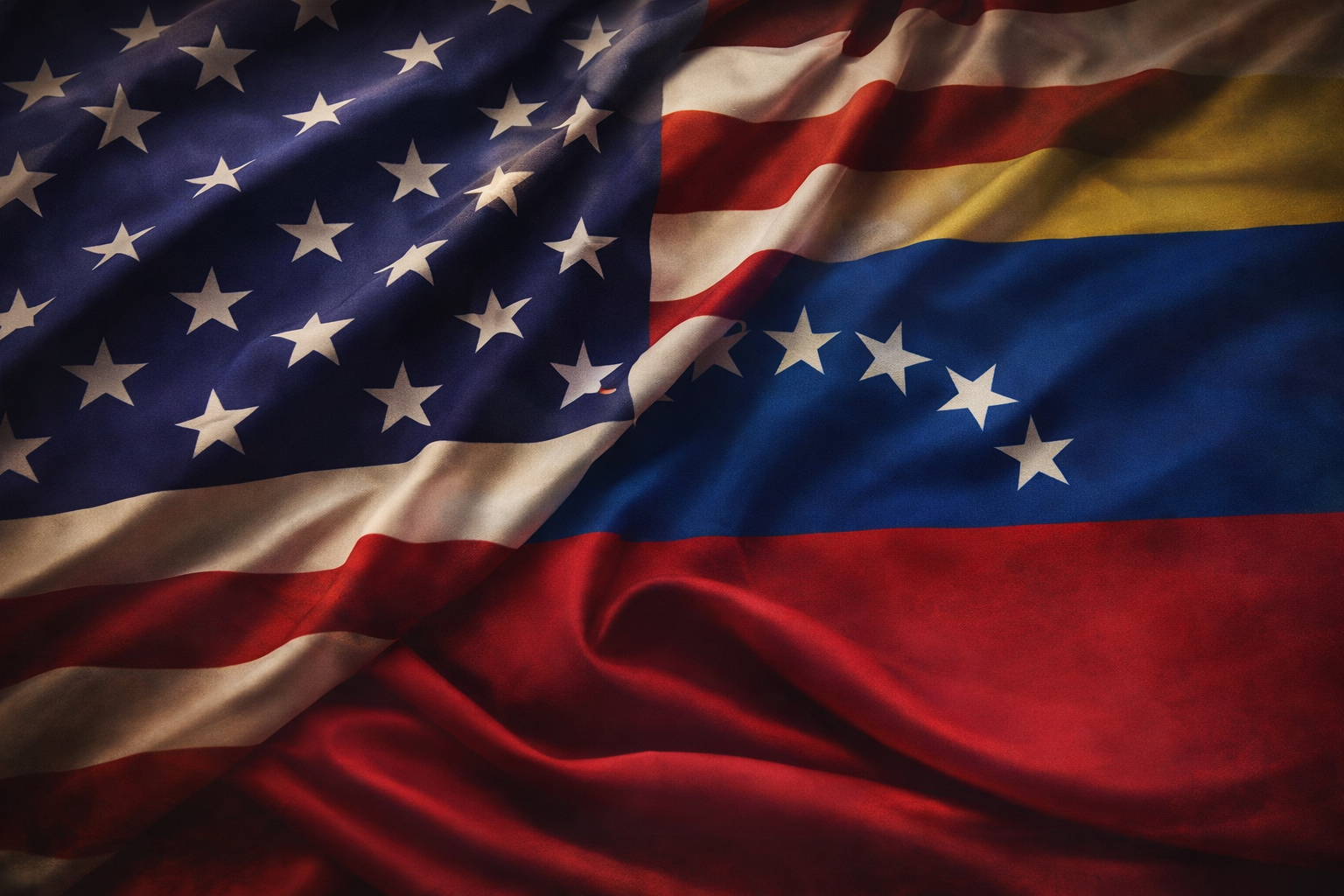
The Trump administration said U.S. forces carried out a military operation in Venezuela, captured President Nicolás Maduro and his wife, and transported them to the United States to face federal charges. In remarks and reporting across outlets, the stated rationale centered on narcotics and an arrest-and-extradition frame tied to “narco-terrorism” allegations, while the operational facts included strikes inside Venezuela, the detention of the country’s top leadership, and uncertainty about who governs next.
President Donald Trump said the United States “will run” Venezuela during a transition period and described a plan to install an interim governing group, adding that the people behind him at a press event would be involved “for a period of time.” He also said U.S. oil companies would “go in” to repair Venezuela’s oil infrastructure and “start making money for the country,” without providing a detailed timeline, legal framework, or electoral roadmap for a transfer of power.
Venezuelan officials disputed the legitimacy of the move and framed it as coercive regime change. In coverage describing competing claims, Venezuela’s vice president, Delcy Rodríguez, publicly insisted Maduro remained Venezuela’s “only president” and accused the United States of forcing political change to enable the seizure of the country’s natural resources. U.S. officials and allies, by contrast, emphasized the arrest-warrant rationale and argued the president acted under inherent authority to protect U.S. personnel executing the mission.
Legal and policy questions quickly became part of the story’s core: the operation occurred without prior congressional authorization, and debate centered on whether criminal charges and Article II powers can justify cross-border strikes, detention, and temporary U.S. control claims. At the same time, the administration’s own language about governing Venezuela and directing oil-sector activity raised fresh questions about whether “law enforcement” was the full description of what the United States is attempting to do.
Why it matters: When a U.S. operation removes a foreign head of state and the president says the U.S. will “run” the country, the dividing line between arrest, intervention, and regime change becomes consequential. A neutral record needs clarity on authority, governance plans, and what facts are confirmed versus asserted by officials on all sides.
Claim: Trump said the U.S. “will run” Venezuela during a transition period.
Origin: President Donald Trump’s public remarks, as quoted in contemporaneous reporting.
Verdict: ✅ True
Rationale: Multiple outlets quote Trump using “will run” language about Venezuela and describing an interim governing arrangement. The statement is attributable and on the record. Source: MS NOW
Claim: The operation was not regime change; it was primarily about drug trafficking and executing criminal charges.
Origin: Administration-aligned framing in coverage and official statements emphasizing narcotics and arrest-warrant logic.
Verdict: ⚠️ Misleading
Rationale: The record includes law-enforcement language and narcotics charges, but the same coverage also reports Trump describing U.S. governance over Venezuela and directing oil-sector actions, which goes beyond a narrow arrest frame. That expansion makes “not regime change” an incomplete characterization of what the U.S. claims it will do. Source: AP
Claim: The president did not need prior congressional authorization for this action.
Origin: Defenses by administration figures and supportive lawmakers invoking Article II / “inherent authority,” especially tied to protecting U.S. personnel executing the mission.
Verdict: ❓ Unsupported
Rationale: Coverage documents that Congress was not notified in advance and that legality is contested; reporting describes arguments offered, but not a settled legal determination that conclusively resolves the authority question for strikes, capture, and temporary governance claims. This remains a debated legal assertion rather than a confirmed fact. Source: MS NOW
Claim: Venezuela’s vice president accused the U.S. of forcing regime change to enable seizure of Venezuela’s resources.
Origin: Public statement attributed to Delcy Rodríguez in coverage describing the Venezuelan government response.
Verdict: ⚖️ Alleged
Rationale: The accusation is reported as her claim and reflects Venezuelan government messaging; it asserts a motive (resource seizure) that is not independently established in the public record at this stage. U.S. statements about oil-sector involvement may fuel the allegation, but the motive claim itself remains an allegation. Source: MS NOW
Rationale: Reporting shows the administration publicly linking the operation to narcotics charges while also describing plans for U.S. involvement in Venezuela’s oil industry, which creates fertile ground for motive speculation. However, public evidence in the reporting does not establish a coordinated pretext plan or prove “purely” resource seizure as the sole driver, so the claim exceeds what is currently documented. Source: AP
| Outlet | Bar | Score |
|---|
| Outlet | Spin | Factual integrity | Strategic silence | Media distortion |
|---|

