
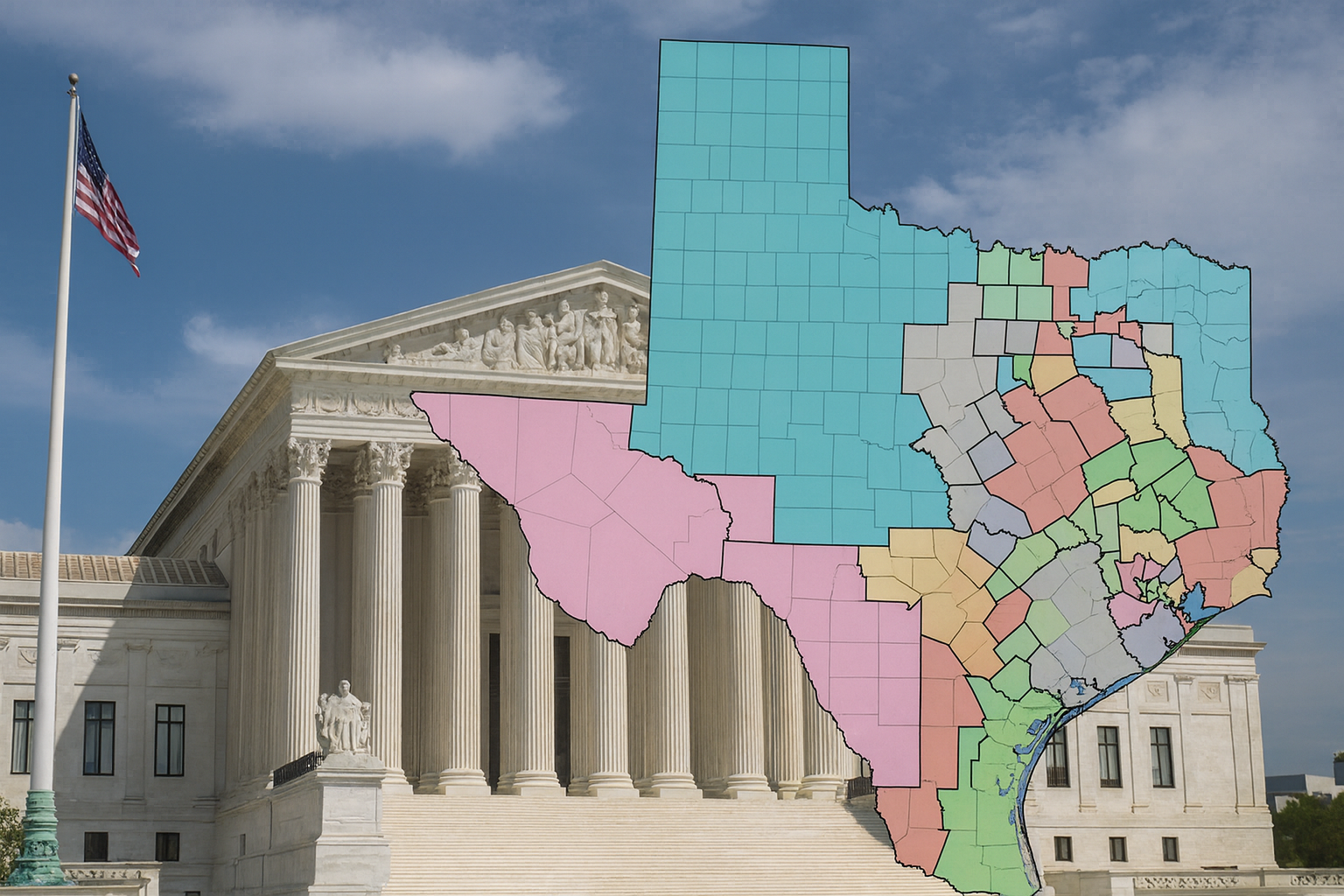
On December 4, 2025, the U.S. Supreme Court granted Texas an emergency stay allowing the state to use its newly enacted 2025 congressional map for the 2026 elections while litigation continues. The stay pauses a federal three-judge panel’s injunction that had blocked the map after finding challengers were likely to succeed on claims that the plan constituted an unconstitutional racial gerrymander.
The Court’s action was procedural rather than a final ruling on the map’s legality. In granting the stay, the majority emphasized interim-relief standards and election timing, criticizing the district court for not applying a presumption of legislative good faith and for drawing adverse inferences without challengers proposing an alternative map that also satisfied Texas’s stated partisan objectives. The Court warned that altering district lines close to an election cycle risks significant disruption.
Texas has been consistent in its defense of the map. State officials describe the redistricting as routine partisan line-drawing designed to increase Republican electoral advantage, and they deny that race was a motivating factor. Challengers, by contrast, argue that race was used as a tool to engineer partisan outcomes — a distinction that matters constitutionally because racial gerrymandering is prohibited even when pursued for political ends.
The lower court credited the challengers’ theory at the preliminary stage, finding that the evidence likely showed racial sorting. Justice Elena Kagan, joined by Justices Sonia Sotomayor and Ketanji Brown Jackson, dissented from the stay, arguing that the Supreme Court should not have displaced that fact-finding on an emergency posture. The dissent warned that keeping the map in place would, as a practical matter, govern the 2026 elections even though the merits remain unresolved.
Much of the public disagreement surrounding the ruling centers on what the stay does and does not signify. Some commentary treats the decision as an implicit endorsement of the map’s legality or as a guarantee of specific electoral outcomes, while other coverage stresses that the ruling settles neither the constitutionality of the map nor the ultimate partisan results. Those points of confusion form the core factual disputes addressed below.
Claim: The Supreme Court’s stay amounts to approval of Texas’s congressional map as constitutional.
Origin: Partisan commentary treating the stay as a merits ruling.
Verdict: ❌ False
Rationale: The Court issued an emergency stay pending further proceedings. It did not rule on the constitutionality of the map. A stay addresses interim relief and election timing, not final merits. Supreme Court order (PDF)
Claim: The lower court definitively proved Texas engaged in racial gerrymandering.
Origin: Overstated summaries of the district court’s injunction.
Verdict: ⚠️ Misleading
Rationale: The three-judge panel found challengers were likely to succeed on their racial-gerrymandering claims at the preliminary-injunction stage. That assessment is not a final adjudication on the merits. Reuters coverage
Claim: Texas concedes that race played a role in drawing the map.
Origin: Commentary collapsing partisan intent and racial intent.
Verdict: ❌ False
Rationale: Texas’s position, as described in coverage and filings, is that the map was drawn for partisan advantage and that race was not a motivating factor. Whether that denial is credible is disputed, but the denial itself is explicit. AP reporting
Claim: The stay guarantees Republicans will gain a specific number of House seats in 2026.
Origin: Triumphal framing and seat-count certainty in partisan coverage.
Verdict: ⚠️ Misleading
Rationale: While the map may make some districts more favorable to Republicans, actual seat outcomes depend on candidates, turnout, national conditions, and potential future court rulings. Projections are not guarantees. Reuters analysis
Claim: Keeping the map in place now effectively means it will govern the 2026 elections.
Origin: Dissent-focused coverage and legal commentary.
Verdict: ⚖️ Alleged
Rationale: The dissent argues that election timelines make later changes unlikely, while the majority treats the stay as temporary. Whether the map ultimately governs 2026 depends on how quickly the case proceeds and how courts rule on the merits. Order and dissent (PDF)
Baseline principle: In prior racial-gerrymandering cases, including Cooper v. Harris, the Supreme Court has emphasized that trial-court factual findings are reviewed for clear error and are entitled to substantial deference, particularly when they rest on extensive evidentiary records.
Current application: In this case, the Court granted an emergency stay that set aside a lower court injunction grounded in detailed factual findings of likely racial discrimination. The stay focused on interim-relief standards and election timing, without assessing whether the district court’s factual conclusions were clearly erroneous.
Assessment: Severity 4 — Strong inconsistency. While framed as procedural, this departure from the Court’s stated deference standard has the practical effect of insulating challenged election rules from fact-based enforcement. Because such emergency interventions most often arise when Republican-drawn maps or voting regulations are enjoined, the inconsistency operates asymmetrically—providing greater protection to Republican election rules even without a merits determination.
| Outlet | Bar | Score |
|---|
| Outlet | Spin | Factual integrity | Strategic silence | Media distortion |
|---|
Reuters: Maintains procedural emphasis and labels claims as allegations tied to posture; minimal moral language; broad national context reduces single-frame pressure.
AP: Strong on factual scaffold with ample quoted reactions; some emphasis on “Trump-backed” stakes, but it remains anchored to who said what and what the Court did.
CNN: Stakes-first framing with a short developing format; fewer legal mechanics and less evidentiary context elevates politics over doctrine in the reader’s takeaway.
MSNBC: Dissent-forward and rights-centered framing; emphasizes emergency-docket critique and the lower court’s findings; less focus on the majority’s strongest arguments for pausing relief.
Fox News: Frames the stay as predictive of Texas’s eventual win; highlights lower-court errors and partisan advantage; downplays the lower court’s evidentiary record that supported the injunction.
Newsmax: Treats the stay as a decisive victory and spotlights seat gains; thin on legal nuance and dissent; encourages “final outcome” interpretation from an interim order.